Thursday, August 2, 2012

A TASTE OF NEW YORK


THREE THINGS THAT INSPIRED ME IN NEW YORK THIS MONTH
On every trip to New York I try to find something new and inspiring. This usually requires nothing more than turning a corner anywhere in any one of the five buroughs. I'm limiting my finds this month to three because if I don't set a limit I'll never get this post out in time. As it so happens this month the three finds are seemingly food related but the design aspect of all of them is always present.

HOW TO DO SEATING IN A SMALL SPACE
I know this may seem to some like beating a dead horse. I've highlighted this franchise so often they should give me one or at the least make me an honorary spokesperson but here I go again. Rice to Riches. This time it's not about the delicious rice pudding, although we did try the chocolate chip flirt with some decadent vanilla caramel sauce. It was an Asian version of the Wisconsin turtle sundae; sweet, smooth and a little salty. It wasn't about the signage where "skinny bitches aren't allowed" or where "the premises are only occupied by compulsively obsessed dessert-loving people with no self-control or discipline". This time it's solely architecturally utilitarian. I went with my sister. I couldn't contain myself from sharing the experience with a rice pudding virgin. The weather this trip was hot, humid and just a touch smelly so rather than buying our rice pudding to go we decided to avail ourselves of the air-conditioned interior and seat ourselves at one of the hip disk-shaped tables squeezed into the back of the shop. The seats are a long built-in banquette, which helps on saving valuable floor space, but the ingenuity comes in suspending the tables from the ceiling rather than anchoring them to the floor. It's such a simple idea but how many other places have you seen that utilize this obvious space saving idea? By suspending the table neither of us had to hassle with negotiating our legs around cumbersome table legs. We just slid in and out. No bruised knees, no having to spread our legs around an obstacle course of vertical impediments, just a comfortable seat with plenty of room to stretch out in what was a minimum of space. Genius.

TACOS SERVED FROM A VW BUS
A trail of dust lifts into the air off the dry dirt road snaking down the Mexican coastline. Janis Joplin's whiskeyed voice warbles out the lyrics from Mercedes Benz from an eight track in the back of the 1962 Volkswagen bus. A half dozen deep brown cerveza bottles roll back and forth across the floor as the bus heaves its way over the potholes on that dry dust covered Mexican road.
In New York you don't have to go any further than Elizabeth Street just below Houston (that's pronounced house-ton for all you Texans who think they named it after your second largest city) to relive that hippie road trip. The experience comes complete with the VW bus all decked out as taqueria. Tucked into a former auto repair garage is Tacombi at Fonda Nolita, a Mexican restaurant where you can get horchata, Mexican beers by the dozen, sangria and for those of us with kids aguas frescas. I chose the watermelon with a hint of lime which I was told was made fresh daily.
They recommend you purchase their tacos and quesadillas in groups of three but I was very happy with two. My Alambre del Rey quesadilla, a beef and bacon concoction, was perfect if a little on the mild side. If my Spanish weren't so rusty I might have remembered that the poblano in my pollo poblano taco was a type of chili pepper. This little piece of knowledge might have helped prevent the three-alarm fire that ignited in my mouth with the first bite into this Mexican delight. All things considered it was still worth the two o'clock in the morning Pepto-Bismol run which I consider to be much better than the possible gift of Montezuma's revenge. When what you want is cheap but hip, Tacombi is a great choice.

HOW TO PUT TOGETHER A TOTAL CULINARY EXPERIENCE
I try to keep up with a handful of blogs that I find inspiring. I use them for their innovation and ability to unearth stories I might not find on my own. A short time ago, Remodelista ran a post on a space they had discovered in New York, a specialty food shop, cooking school and event space called Haven's Kitchen. I was mesmerized by this space from the first picture in the post. As I read on my interest continued to grow.
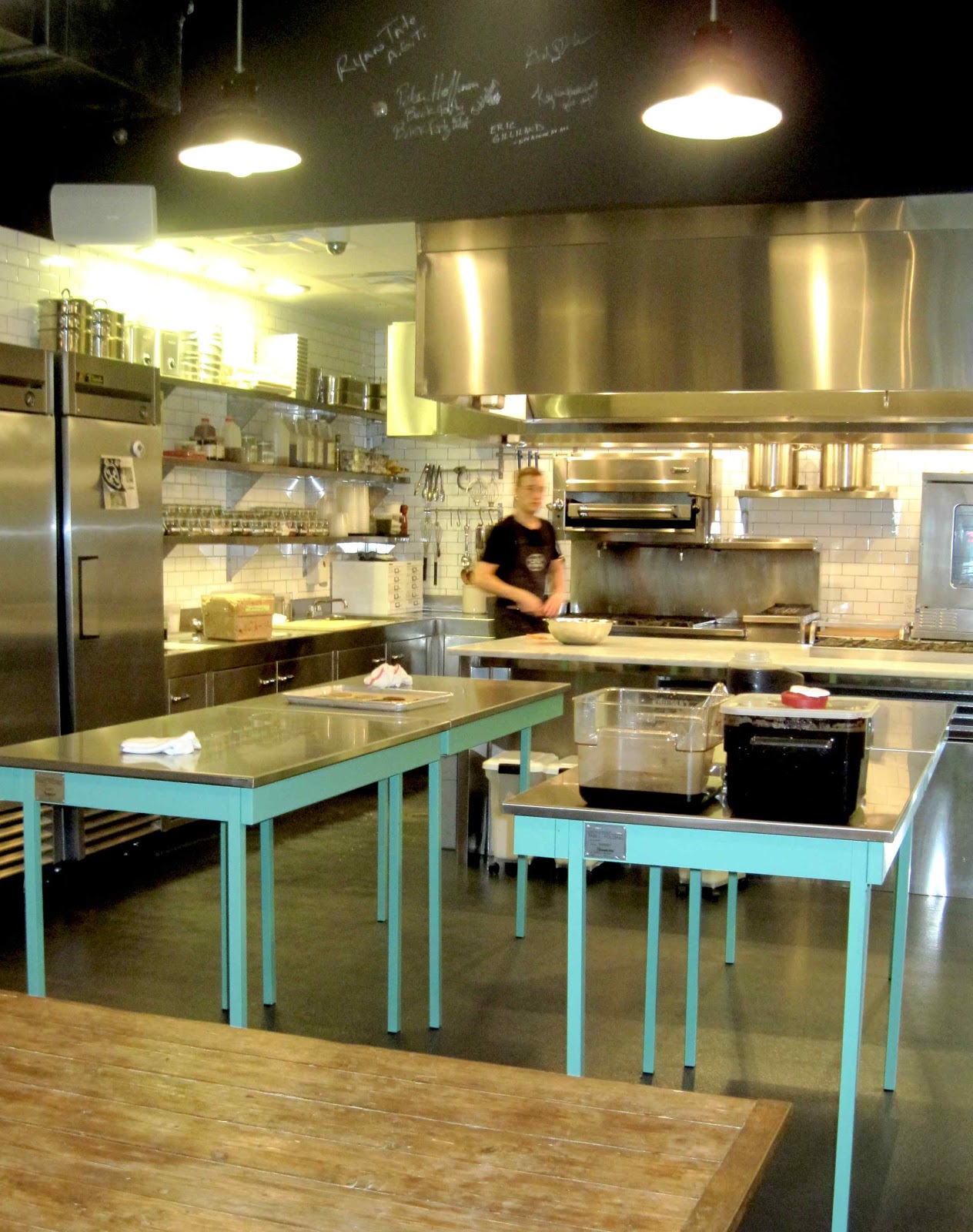
I knew I was going to have to seek it out once I got my feet on the ground in the city. Once I got there, there were so many things that captured my interest I immediately got out my camera and started collecting images.The first thing was the design. Under the meticulous eye of creator, Alison Schneider, every detail was attended to. There's a friendly vibe to the interior where a kitchen cleanliness mingles with an industrial rawness making for an unpretentious space you can spend hours in looking at all the great products perfectly lining the wooden and metal shelves.
The next aspect that intrigued me was its location. At 109 West 17th Street it is located almost directly across the street from our old studio location. For as many years as I can remember the original carriage house was shoji screen store. A Japanese gentleman with a huge shock of white hair and a matching mustache was always stationed at the front door. You couldn't help but love the beautiful brickwork of the exterior.
The space also houses a kitchen school teaching healthy cooking skills using local and organic products for the whole family.
You can a class in rustic seasonal desserts, or vegetarian paella and Spanish wines, or how about a class called Steve's ice cram social.
In addition to the classes, once a month they bring in a dream team of chefs to host an evening of inspired cooking with the chefs present for the entire event. This is something you want to book well in advance. It's a very hot ticket.
In addition to all of this, up the curved staircase on the second floor is party space you can rent out for your own private event.
This is an idea that is the full package. Alison has left no omelet unturned in the world of culinary innovation and food preparation.


THE GALLERY
Tuscan Lemons, 2000
Cy DeCosse, photographer
Represented by Weinstein Gallery, Minneapolis

Friday, July 27, 2012

MATTE WHITE POTTERY


VINTAGE POTTERY
Some people line their shelves with books of famous authors, spines bearing the titles, "Tropic of Cancer", "For Whom the Bell Tolls" and "Fifty Shades of Gray". Others dust around framed photos of family and friends. We like to line shelves with pottery. We'll go out on a limb and bring in some vintage Roseville and we can appreciate the cobalt blue of a shelf lined with Delft but our hearts belong to the simplicity of the mid-century matte white vases made by pottery companies and supplied to florists around the country.
It wasn't long ago that we could scour the flea markets and multi-dealer antique malls of Wisconsin and Georgia and come back with truckloads of Haeger, Rookwood and Redwing, even Roseville pottery, all for a song. We'd wrap our finds and cart them back to our little country store in the mountains of Upstate New York where we'd sell them at a normal retail based mark-up. We were never into book value pricing or arm-and-leg price hikes. The pottery would fly off the shelves. We'd keep a piece here and there for ourselves watching our own collection grow beyond the fireplace mantle and begin its spread onto the tops of dressers and into the open nooks of built-in bookcases. For me there may have been a personal connection. My father was from Dundee, Illinois, the home of Haeger Potteries. Started more than a hundred forties years ago as a brickyard it came to prominence after the great Chicago fire when rebuilding began and the material of choice was something a little less flammable than wood. Some time around the turn of the century the Haegers turned their efforts and their clay toward the production of ceramics. I can remember on family visits back to Dundee my Mother dragging me to the seconds shop at the Haeger Studios where she'd pick up a couple of vases, always matte white. We had a huge horizontal mirror in our living room with a glass shelf. My Mom displayed her vases filled with ivy and a questionable figure of a black man with a white turban and white flowing pants, a gold chain and arm bracelet attached to a ferocious looking black panther standing center stage on the glass shelf. My Mom actually had quit a flair for design.
Here are some pieces from our collection that we're particularly proud of:
Starting with what can be the hardest thing to pull off these tall slim vases show perfect proportion. The addition of the pedestal bases gives the right touch of detail. Don't ask us to ever part with this trio.
These two vertical vases take the form a little further, deconstructing the cylinder and putting it back together in a series of geometric shapes pushing form to the edge of innovation.
This series of vases shows how diversity works so well in our household. Not only is it a concept that works for humanity it also works for the vases on your shelf.
The matte white is not only found in vertical vases but it can be found in some very graceful horizontal forms as well. This is one of our favorites.
And here are some other people who have managed to use pottery in ways that make our drool buckets fill to the brim and dribble just a little over the edge.


THEFT
This is such a small thing but at the same time it takes a big divot out of my image of Madison. New York and New Yorkers have had an image problem with the rest of the nation for decades. The stereotypical perception is one of rude pushy people scurrying around like a bunch of rats, self-possessed and entitled. We had a small country store in a little Upstate hamlet populated mostly by New York City weekenders. Most of our neighbors chose this area as a place to exhale, breath in a little mountain air and relax. Days were spent poolside at the community pool or weeding vegetable gardens and evenings were filled with rotating impromptu dinners and cocktails parties that lasted until the kids had fallen asleep on the couch. After we had put in some shallow roots we opened a small country home and garden store on our block long Main Street. We were only open Thursday through Sunday during the high tourist season. Rick and I actually fought over counter time at the store. It was a real social event where you didn't know who was going to come through the door. We had celebrities, restaurateurs, advertising executives, local construction workers, and the waitress from across the street, all come in to enjoy the shop. During our ten-year tenure I only once had to deal with a theft. A regular customer had come in with a friend. I watched as the woman's friend picked up a twelve- dollar book on cigar labels and tucked it under her coat. I debated saying something but then decided against it. The woman was a good customer and her friend obviously had a problem. It wasn't worth the twelve dollars. It was the only time to my recollection where anything was lifted from our store.
Madison's story has not been quit the same. I'm going to ignore our stint at a local antique mall. They warned us about putting valuable items out, not storing them behind lock and key. We lost several valuable pieces of Roseville pottery by not adhering to their warning. Undeterred we've continued to believe that in Madison we're not supposed to have to lock our doors or hide our valuables. Our retail business has been tough to get off the ground. A lot of people have tried to convince us to do something with some more obvious signage to point a bigger finger at our store. We are on a bike path with a fair amount of bike riders passing by. I couldn't bear to do a sandwich board or a flashing neon sign so I concocted a tableau of vintage flags, a contemporary side table and the open/closed sign we had used at our store in New York. I placed my tableaux curbside in the hopes of drawing some attention to the store. It was a sign our daughter had packed up when we left New York. It was her idea to use it here in Madison, her good luck charm for the store. Saturday in the middle of the day while I was working on some construction drawings in the back room someone came by and snatched the sign. I don't think it looked like trash. I don't think the bike riding population are a particularly nefarious breed but I'd like to think that whoever took it thought it was something set out as a freebee. I hope they'll see this and think about their karma and return the sign. Here's hoping Madison proves to be what I know it really is.

THE GALLERY
Weegee on his Studio Fire Escape, Ca 1939
Photographer, Unknown
Available from Getty Images

Thursday, July 19, 2012

TOURING 200 LEX


THE TED BOERNER SHOWROOM
Since we've been a part of Access to Design I've been trying to familiarize myself with the hallways and showrooms at 200 Lex, NYDC. I can't speak for other designers but I know I rely on certain showrooms as my go to vendors. After several months of pushing buttons in the elevator for floors I had never even set foot on, it didn't take me long to realize I was the one losing out by not having done this type of exploration before. So I set myself a goal to introduce myself to each showroom and then write a little bit about their product. I don't know about you but I'm a little intimidated about going up and making a cold introduction. I would have faired much better in the Victorian era when everything was done with a calling card. Anyway, to easy my insecurities I devised a set of ten questions to present to staff at the showrooms as a sort of icebreaker.  I also decided to cheat a bit by starting off with some of the showroom people I already knew. This is a series that I'll be inserting into the blog on a regular basis. So lets get ready for a the start of our tour.
The first door I'm going to open is at the Ted Boerner Showroom. Ted hails from a prominent Wisconsin family although he contends the prominent part of the family was a bit removed from his. His personal history weaves its way through theater and dance into set design and eventually into establishing the furniture line he has become famous for. Ted describes his approach to furniture as, "straightforward, exploring familiar forms, and using only essential details. In search of simplicity, we balance the idiosyncrasies of nature with the clean rhythms of modernism."
The truth of this lays in the simple beauty of his pieces. Ted's work moves into the realm of classic or perhaps it floats there. His Cloudbox Cumulus sofa is perfect. The asymmetrical quilting on the back is outside the expected, an elegant touch to a skyward inspired sofa that becomes art.
In the Reverie media unit one can again see the strength of his simplicity in design and his use of modernist  rhythms.
The New York showroom is headed by Steven Rappos. Steven's experience in the arena of high-end furniture and textile design spans almost two decades. We have known Steven for almost his entire career. He has been a tremendous supporter of our work and a true sounding board for our ideas.  Here's how Steven answered our ten questions:


TEN QUESTIONS FOR SHOWROOM MANAGERS
1. What's the mood like at your showroom?
We want the mood to be comfortable and relaxed. Our goal is to show our uniquely detailed and hand-made products. 
2. What's the strangest request you've had?
There are too many to even think of...perhaps a better question would be, how do prevent cynicism. 
3. What's your most popular item or category?
Upholstery & casegoods
4. Who's your most famous client?
Disclosure agreement signed...but a famous composer
5. What was your biggest sale?
It was for an entire apartment on the north side of Madison sq. Park. It was very nice.
6. How often do you change around your showroom?
Big changes typically happen twice a year-with some minor adjustments frequently. 
7. Other than your own showroom where do you shop for furniture?
I like Robert Kuo's collection. Then there are the fellas as Hickory Chair in the NYDC 200 Lex that provide great service and well priced products.
8. What do you offer that retail can't offer?
Service and customization. We also offer one-of-a kind hand-made products made in the US. 
9. What color, wood species or fabric are clients asking for?
Walnut species typically in a variety of stains- it seems to the be classic benchmark. 
10. What's your prediction for next year's hot trend?
Trends happen so quickly now and I've been in the industry for almost 20 years- so I've seen a recycling of trends already.  Fashion tends to be a good indicator- it used to take about 2-3 years for the effect to be seen in our industry but now with faster production and digital capabilities for printing, it happens much faster- typically 6 mos. To a year. 

In addition to his own line the New York Showroom also represents such artists as Tracy Kendall and her amazing wall coverings. She has created three-dimensional papers, photographic sheets and papers suitable for outdoor use. My favorite is the tiny mother-of-pearl buttons adhered to a backdrop with plastic hangtags. The patience to manufacture this particular paper is an attribute I don't come close to possessing.
Conde House is another line found at the Ted Boerner Showroom that brings a more Asian sensibility to the space. It's a great compliment to Ted's pieces.


THE GALLERY
W 37th St, 8th Ave. NY, NY
Chris Woodcock, photographer
Represented by Bonni Benrubi Gallery, New York


Thursday, July 12, 2012

LIBRARIES


A QUIET CORNER FOR SUMMER READING
Normally the heat of summer would drive the masses to the beach to cool their bodies in the refreshing surf and drown their minds in the summer’s biggest pot-boilers but the extreme heat of this summer has pushed many of us into the cooler air-conditioned corners of our homes where we can curl up with that same book and avoid the sweat and sunburn of this massive heatwave. Besides, global warming has added another ten degrees to the water temperature so it isn’t all that cool there anyway, and what about all those sharks.
Here are some of my favorite home libraries:
There’s something about the security of small spaces. Animals, by nature, gravitate toward them. Dogs will curl up under a sheltering table. Cats will hide in a cardboard box. Humans, on the other hand, profess to a motto of bigger is better but I’m not so sure we all really believe in that. The sheltering nature of this enclosed library has always been very appealing to me. There’s something very inviting about a space where I could be surrounded by my favorite authors sharing the music I liked to listen to without the snide comments from a sarcastic teenage daughter or a partner who’d rather listen to Dwight Yoakum than the Bombay Dub Orchestra.
There are numerous approaches to home libraries but if I was to establish a far right and then a far left approach I think these two spaces illustrate the dichotomy. There are those of us who have a place for everything and everything has its place. Neatness is one of God’s most precious gifts and damn the person who fails to use a coaster or doesn’t remove their shoes before they cross my front door. I could read a book here but I doubt I’d allow myself to drape a leg over the arm of that pristine chair while I read.
On the other hand there are those far less concerned with order and more attuned to comfort. As far left leaning as I may be this may be a little to far to the left for even me. If there were a comfy chair available I’d enjoy my book here but I’d probably stumble out of here with bits of dark chocolate melded into the fabric of my shirt and an embossed book cover pattern embedded into my right cheek where I feel asleep on against one of those dust piles of earthy smelling books
Celebrities have some of the most impressive and grandest libraries on record. They can afford it. Two of my favorites, and for very different reasons, are Diane Keaton’s Spanish Colonial Revival inspired library and Karl Lagerfeld’s ode to the printed page. In Ms. Keaton’s library, (I believe the house has since been sold and she has moved on) which is also the entry to the house, the walls are lined with books about the visual arts – her passions. There is a groin vaulted ceiling capping off the room. The vaulted ceiling then sets on a quote embracing her philosophy, “The Eye Sees What the Mind Knows”. I could spend a great deal of time here thumbing through her collection.
In Mr. Lagerfeld’s library one has to be impressed with the volume of his volumes. I don’t know how many years an average human has to his life but I doubt the ability of anyone to get from one end of his library to the other before rigor mortis would set in. It still would be a happy death.
Sometimes a library is only a small corner in a room with personal items and a series of books that one can actually manage to read and become familiar with in a lifetime. This particular client of ours lives a simple life and the artifacts of his corner library paint a picture of the man who actually reads these books.
What young reader wouldn’t be enticed into a journey of reading with a library as interactive as this one? I have no idea of how this chain and sling work but I’d bet even the most hyper-active of kids would agree to reading a few pages for a chance to swing through this library.


STORING YOUR BOOKS
Most people end up shelving their books by size, if it fits on the shelf that’s good enough for them. Some of us may be a bit more anal. I know I, at least, try to categorize my collections. I know others who do more of a Dewey Decimal System or alphabetize their tomes. But there are a few who have come up with more design inspired solutions to storing their books. Here are a few for you contemplate:
I find shelving by color to be very amusing. The look can be terrific if you are fortunate enough to have found books with spines of many colors, but I find it hard to remember titles by their pantone jacket color. At last year’s Dining by Design in New York Benjamin Moore did a room were the walls were lined with books. Each book had a dust jacket in a specific Benjamin Moore color and the spine identified the color. Now there it worked.
Another great trick is to buy books whose jackets match your décor. This works when the look of the room is more important than the content of the reading material. Now mind you I’m not against this. This can make for a beautiful room and how many books can one person read anyway. And besides, you could always drop a Kindle E-Reader into the drawer on the bedside table.
When you’re tired of the messy look of all those miss-matched spines you can chose one of these two ways to clean up the unattractive look of actual books. You can take all your books and make your own dust jackets out of newsprint or parchment. This gives an even non-confrontational look to any space. You can also hide all those titles you’re not so sure you want any of your far-right Christian relatives to see.
And if this technique is too time-consuming you can do what this inventive reader did. Take all your books and turn them backwards so all you see is white and off white of the page edges. Either of these ideas give you the uniformity you were looking for, they just make find what you’re looking for a little more difficult when you can’t quit remember where you hide your latest guilty pleasure.

THE GOD BOX
Fate and faith are difficult concepts for some of us to wrap our heads around. My most recent summer reading has had a very personal link between these two concepts. I’ve never been a very strong follower of organized religion yet I’m probably one of the most secretly superstitious people I know. I have so many rituals I’d need pages to identify them all. Things like if I don’t make my bed in the morning the whole day is going to be ruined. If I wear a particular watch and the day goes well I’ll continue to wear that watch until its magical good charms wear off. I’d never pick up a penny off the street if it wasn’t heads up and any itchy palm, a supposed indicator of incoming money, will put a huge smile on my face. The list could go on and on. A few weeks ago a local paper was running a competition for Madison’s “Best”. They provided an online ballot for readers to vote in several categories. We needed some additional publicity so we sent out an email blast to our mailing list asking for all our readers to vote for Pleasant Living. We cast a wide net sending out as far as the Netherlands and Italy. How was the Isthmus going to know where our customers might come from? One of the emails landed on the facebook page of a friend in upstate New York and that got passed on to another friend who we had lost contact with several years ago. That friend, Mary Lou Quinlan, wrote a note to our daughter on our upstate friend’s facebook page and that’s how it got back to us. Mary Lou has recently written a book, “The God Box” and as fate would have it Mary Lou was gong to be at our Westside Barnes & Noble the following week for a book signing. The book is a story of faith, the belief in a God’s power to listen to our problems and struggles and take care of them no matter how big or small. After her mother’s death, Mary Lou and her family discovered a series of boxes filled with scraps of paper, each with a plea to God to help with such diverse requests as helping Mary Lou and Joe pick out the right flooring material for their country home to pleading for a cure for her mother’s rare form of blood cancer. It was a remarkable way of dealing with the stress of life through faith. The intersection of fate and faith brought us back together again and for that I am very grateful. You can pick up the book at your local Barnes & Noble or through amazon.com. Have faith that fate will see you through the big and the small.

THE GALLERY
Measurement
John Chervinsky, photographer
Represented by Michael Mazzeo  Gallery